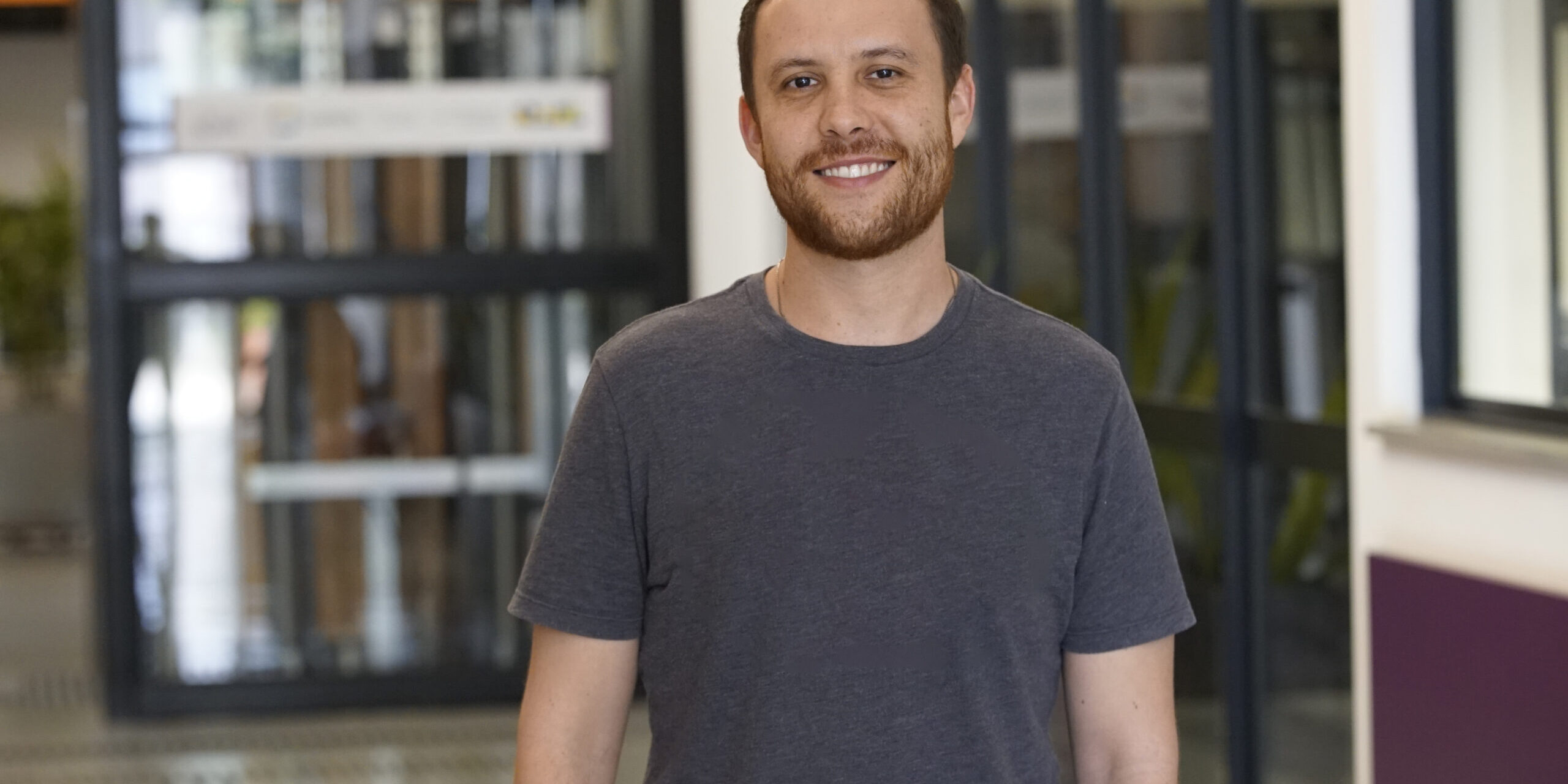
Vinicius Francisco Wasques, a math professor at the Ilum School of Science, the undergraduate degree program at CNPEM (the Brazilian Center for Research in Energy and Materials– CNPEM), has received the NAFIPS Early Career Award, an international honor recognizing early-career researchers who have made significant contributions in the field of fuzzy systems. Fuzzy logic makes it possible to address inaccurate, vague or ambiguous data in a mathematical manner that simulates human reasoning.
The prize, which is awarded by the North American Fuzzy Information Processing Society (one of the leading scientific societies dedicated to the study and development of fuzzy information processing), is bestowed on scientists within ten years of their PhD defense who stand out for the impact of their research. The award has been granted since 2014, and is intended to value new scientific leadership in this area.
In the 2026 edition, Vinicius was recognized for his contributions to research on controlling uncertainty in fuzzy dynamic systems through fuzzy interactivity, a topic that combines different advanced concepts of mathematical modeling to deal with complex and uncertain systems.
As part of the tradition involving this award, the winner is invited to present a lecture on his or her work at a future edition of the NAFIPS congress. Vinicius is scheduled to present at the Brazilian Fuzzy Systems Congress and the North American Fuzzy Information Processing Congress (2027 CBSF/NAFIPS), an event organized in partnership between the Brazilian Fuzzy Systems Society and the North American Fuzzy Information Processing Society.
The congress will be held in Ilhéus in the second half of 2027, and will bring together researchers from Brazil and abroad who work in development and applications of fuzzy systems.
According to Vinicius, the prize represents an important incentive for research continuity and for scientific collaboration in the area.
“It is an honor to receive the NAFIPS Early Career Award. For me, this recognition represents not only a personal achievement, but also an incentive to continue conducting my research together with my collaborators. I am very pleased to receive this award, especially since it comes from NAFIPS, such a traditional society in the field of fuzzy systems. Presenting my research at the next edition [of its congress] will be a great opportunity, even more so with the event being held in Brazil.”
This achievement reinforces the environment of academic excellence at the Ilum School of Science, which brings together young researchers who are active in different knowledge areas, contributing to scientific advancement and shaping new generations of scientists.
About the Ilum School of Science
Ilum offers a free undergraduate degree program that utilizes an interdisciplinary approach to train scientists and professionals in science and technology. With an innovative educational model, the three-year full-time bachelor program offers courses that connect life sciences, materials science, data science, artificial intelligence, and the humanities in order to prepare researchers to work in an ethical and collaborative manner in the search for solutions to the global challenges of the twenty-first century. The Ilum School of Science is funded by the Brazilian Ministry of Education (MEC) and is part of the Brazilian Center for Research in Energy and Materials (CNPEM) in Campinas, São Paulo, a social organization overseen by the Ministry of Science, Technology, and Innovation (MCTI). Ilum’s educational mission offers early contact with experimental activities, in teaching labs at the school as well as at CNPEM, in projects carried out together with researchers.
About CNPEM
The Brazilian Center for Research in Energy and Materials (CNPEM) is home to a state-of-the-art, multi-user and multidisciplinary scientific environment and works on different fronts within the Brazilian National System for Science, Technology and Innovation. A social organization overseen by the Ministry of Science, Technology and Innovation (MCTI), CNPEM is driven by research that impacts the areas of health, energy, renewable materials, and sustainability. It is responsible for Sirius, the largest assembly of scientific equipment constructed in the country, and is currently constructing Project Orion, a laboratory complex for advanced pathogen research. Highly specialized science and engineering teams, sophisticated infrastructure open to the scientific community, strategic lines of investigation, innovative projects involving the productive sector, and training for researchers and students are the pillars of this institution that is unique in Brazil and able to serve as a bridge between knowledge and innovation. CNPEM’s research and development activities are carried out through its four National Laboratories: Synchrotron Light (LNLS), Biosciences (LNBio), Nanotechnology (LNNano), Biorenewables (LNBR), as well as its Technology Unit (DAT) and the Ilum School of Science — an undergraduate program in Science and Technology supported by the Ministry of Education (MEC).