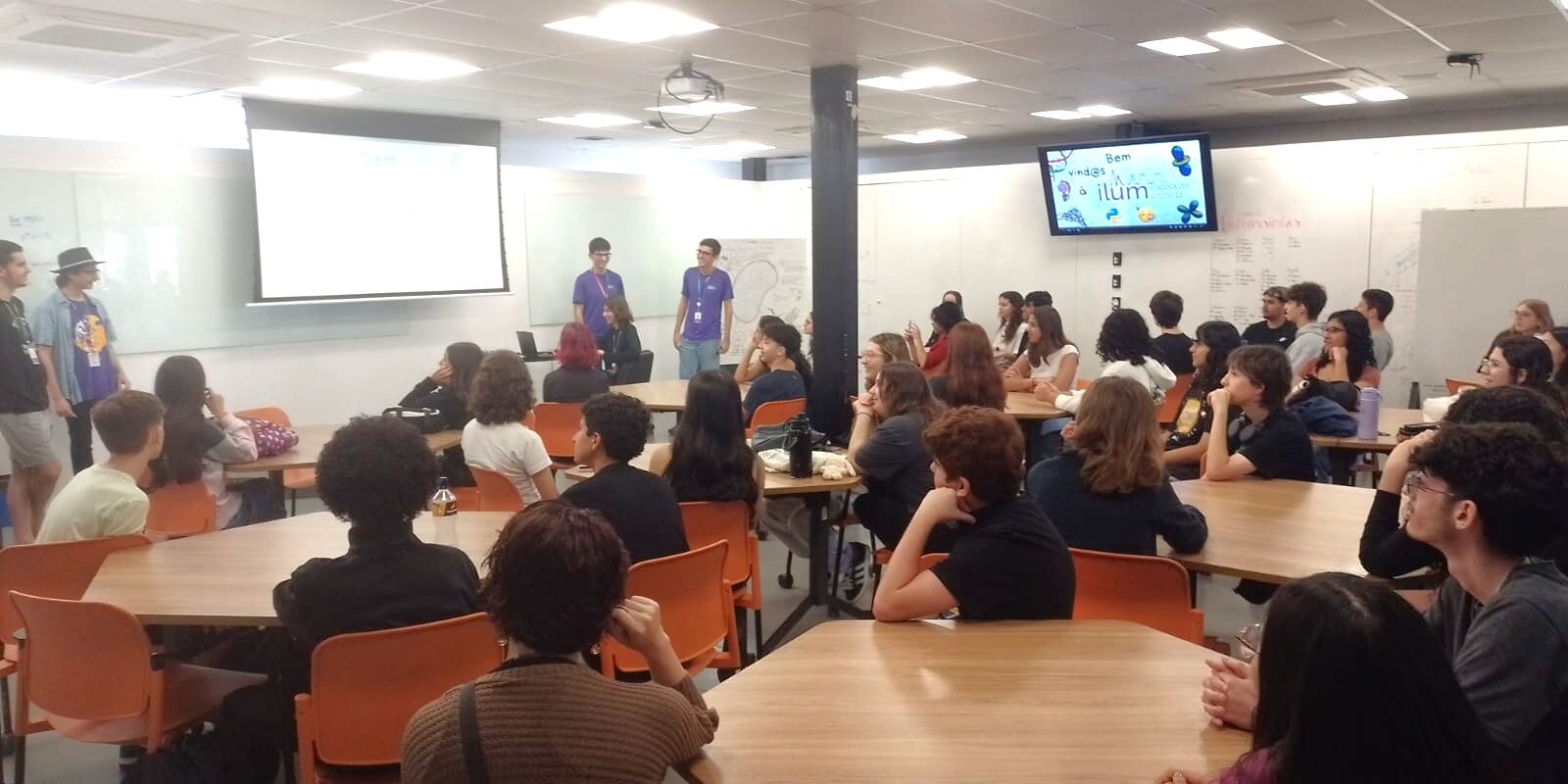
The Knowledge Workshops from the Ilum School of Science, the higher education institution of CNPEM (Brazilian Center for Research in Energy and Materials), began on Saturday, April 11, marking the start of another edition of the program that brings elementary and high school students closer to the scientific world. In 2026, the initiative presents new features: an increase in the number of participants, greater female participation, and a proposal even more focused on experimentation.
In total, there were 102 applicants from different cities in the Campinas region and even from the capital of the State of São Paulo. Following a selection process that considered cover letters and academic records, 40 students were selected, increasing the number of opportunities available compared to the previous year, when there were places for 30 young people. The distribution also prioritized diversity, with 70% of the vacancies reserved for students from public schools.
Another striking piece of data from this edition is the profile of those accepted: 70% are girls, a result that occurred spontaneously, based on the evaluation of the applications.
According to Ana Carolina de Mattos Zeri, responsible for the Workshops, the participants’ engagement was already evident in the first meeting. “It was wonderful to see their interest. Even after the scheduled time, nobody wanted to leave the classroom. This shows how curious and engaged they are with the activities”, she highlights.
On this first Saturday, students were challenged to investigate physics concepts through experiments with balls of different masses, exploring, in practice, ideas such as acceleration and the scientific method. Divided into groups, they formulated hypotheses, tested results, and discussed their conclusions.
For this year, the main change lies precisely in the reinforcement of experimental activities. “We are giving them more direction so that they can place more emphasis on practical application. The idea is to connect the content they see in school with the real experience of scientific investigation”, explains Ana.
Over the course of 16 Saturdays, until the end of October, participants will be exposed to different areas of knowledge. Activities are planned ranging from classic experiments to interdisciplinary practices — such as studies involving chocolate and structural patterns, as well as simple genetic sequencing experiments.
Another distinguishing feature is access to Ilum’s state-of-the-art laboratories and equipment, providing students with an experience close to real-life scientific research. More than just transmitting content, the Knowledge Workshops aim to awaken scientific thinking and encourage student autonomy.
About the Ilum School of Science
Ilum offers a free undergraduate degree program that utilizes an interdisciplinary approach to train scientists and professionals in science and technology. With an innovative educational model, the three-year full-time bachelor program offers courses that connect life sciences, materials science, data science, artificial intelligence, and the humanities in order to prepare researchers to work in an ethical and collaborative manner in the search for solutions to the global challenges of the twenty-first century. The Ilum School of Science is funded by the Brazilian Ministry of Education (MEC) and is part of the Brazilian Center for Research in Energy and Materials (CNPEM) in Campinas, São Paulo, a social organization overseen by the Ministry of Science, Technology, and Innovation (MCTI). Ilum’s educational mission offers early contact with experimental activities, in teaching labs at the school as well as at CNPEM, in projects carried out together with researchers.
About CNPEM
The Brazilian Center for Research in Energy and Materials (CNPEM) is home to a state-of-the-art, multi-user and multidisciplinary scientific environment and works on different fronts within the Brazilian National System for Science, Technology and Innovation. A social organization overseen by the Ministry of Science, Technology and Innovation (MCTI), CNPEM is driven by research that impacts the areas of health, energy, renewable materials, and sustainability. It is responsible for Sirius, the largest assembly of scientific equipment constructed in the country, and is currently constructing Project Orion, a laboratory complex for advanced pathogen research. Highly specialized science and engineering teams, sophisticated infrastructure open to the scientific community, strategic lines of investigation, innovative projects involving the productive sector, and training for researchers and students are the pillars of this institution that is unique in Brazil and able to serve as a bridge between knowledge and innovation. CNPEM’s research and development activities are carried out through its four National Laboratories: Synchrotron Light (LNLS), Biosciences (LNBio), Nanotechnology (LNNano), Biorenewables (LNBR), as well as its Technology Unit (DAT) and the Ilum School of Science — an undergraduate program in Science and Technology supported by the Ministry of Education (MEC).