Students at the Ilum School of Science had the opportunity to take a deep dive into one of the most promising topics in modern science during a visit by the Brazilian physicist Eduardo Mucciolo to the Brazilian Center for Research in Energy and Materials (CNPEM) in Campinas, São Paulo. Mucciolo, a professor in the Department of Physics at the University of Central Florida in the US, gave three lectures for researchers and Ilum students on quantum information and quantum computing, strategic areas that are transforming scientific and technological development at a global scale.
During the sessions, the students learned about concepts related to quantum information, an area that uses the properties of quantum mechanics to develop new computational technologies, sensors and communication systems. Mucciolo believes that even though quantum information is not yet a part of everyday life to the same extent as artificial intelligence, its impact will expand rapidly in the coming years.
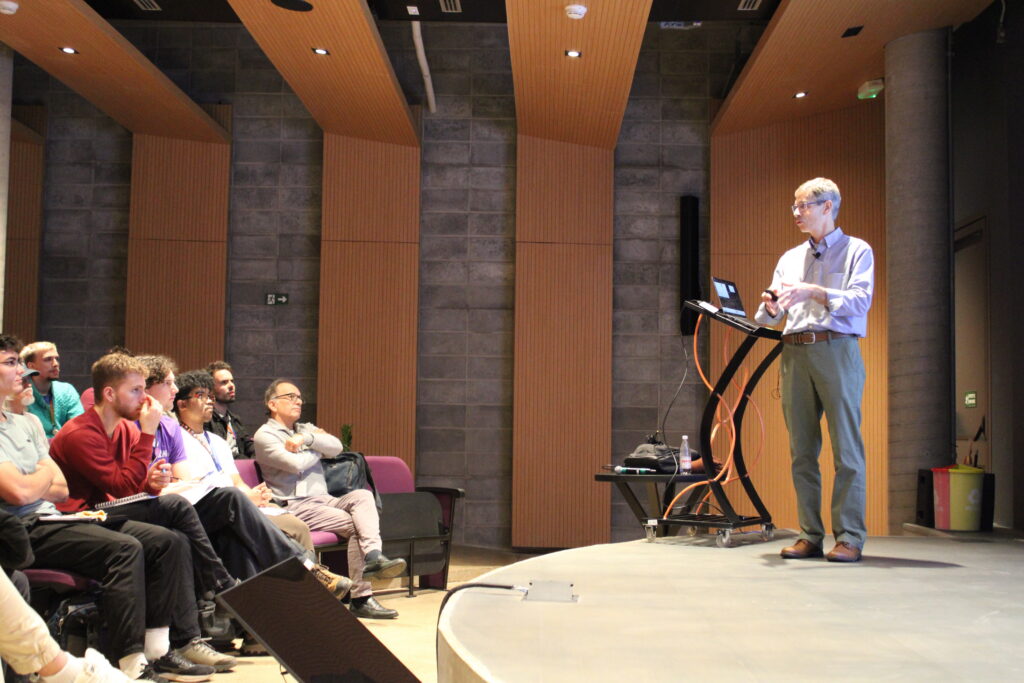
“Quantum computing will be an important tool for developing new medications, new materials and solving extremely complex logistical problems. There will also be applications in sensors and devices for medical diagnostics, for example,” he added.
In Mucciolo’s opinion, progress in this field has already expanded beyond the strictly academic environment, driven by industrial and government investments in various countries. “As soon as quantum computers start solving truly impactful problems, we will see explosive growth in interest in this area, similar to what occurred recently with artificial intelligence. We need to start training professionals to work in this scenario,” he stated.
The visit also demonstrated one of Ilum’s main educational principles: bringing students together with internationally acclaimed researchers as well as emerging scientific topics while they are still undergraduates. Throughout the event, students had the chance to discuss practical applications of quantum information, advances in quantum computing and the scientific challenges involved in developing new technologies based on quantum phenomena.
Mucciolo spoke highly of his experience at CNPEM and the contact with Ilum students. “I had never visited CNPEM, even though I followed its trajectory since the first Brazilian synchrotron. I always heard colleagues speak of the center as a world class environment,” he said. With regards to Ilum, Mucciolo was especially impressed with the institution’s objectives. “Ilum is an extraordinary initiative. I wish I could have participated in a program like this when I was a student. The seriousness, dedication and enthusiasm of the directors as well as the teachers is contagious. I felt the same way interacting with the students,” he added.
International trajectory
With a well-established career in theoretical physics and quantum information, Eduardo Mucciolo earned his doctorate in physics from the Massachusetts Institute of Technology (MIT), after obtaining his undergraduate and master’s degrees in physics from the University of São Paulo (USP). He currently teaches at the University of Central Florida. Mucciolo has also served as the Chair of the Department of Physics at UCF, and has been affiliated with universities and research centers in Brazil, the United States and Denmark.
About the Ilum School
Ilum offers a free undergraduate degree program that utilizes an interdisciplinary approach to train scientists and professionals in science and technology. With an innovative educational model, the three-year full-time bachelor program offers courses that connect life sciences, materials science, data science, artificial intelligence, and the humanities in order to prepare researchers to work in an ethical and collaborative manner in the search for solutions to the global challenges of the twenty-first century. The Ilum School of Science is funded by the Brazilian Ministry of Education (MEC) and is part of the Brazilian Center for Research in Energy and Materials (CNPEM) in Campinas, São Paulo, a social organization overseen by the Ministry of Science, Technology, and Innovation (MCTI). Ilum’s educational mission offers early contact with experimental activities, in teaching labs at the school as well as at CNPEM, in projects carried out together with researchers.
About CNPEM
The Brazilian Center for Research in Energy and Materials (CNPEM) is home to a state-of-the-art, multi-user and multidisciplinary scientific environment and works on different fronts within the Brazilian National System for Science, Technology and Innovation. A social organization overseen by the Ministry of Science, Technology and Innovation (MCTI), CNPEM is driven by research that impacts the areas of health, energy, renewable materials, and sustainability. It is responsible for Sirius, the largest assembly of scientific equipment constructed in the country, and is currently constructing Project Orion, a laboratory complex for advanced pathogen research. Highly specialized science and engineering teams, sophisticated infrastructure open to the scientific community, strategic lines of investigation, innovative projects involving the productive sector, and training for researchers and students are the pillars of this institution that is unique in Brazil and able to serve as a bridge between knowledge and innovation. CNPEM’s research and development activities are carried out through its four National Laboratories: Synchrotron Light (LNLS), Biosciences (LNBio), Nanotechnology (LNNano), Biorenewables (LNBR), as well as its Technology Unit (DAT) and the Ilum School of Science — an undergraduate program in Science and Technology supported by the Ministry of Education (MEC).