Five students from Science Olympiads got to know Sirius, carried out practical experiments and exchanged experiences with researchers and teachers during the five days of programming
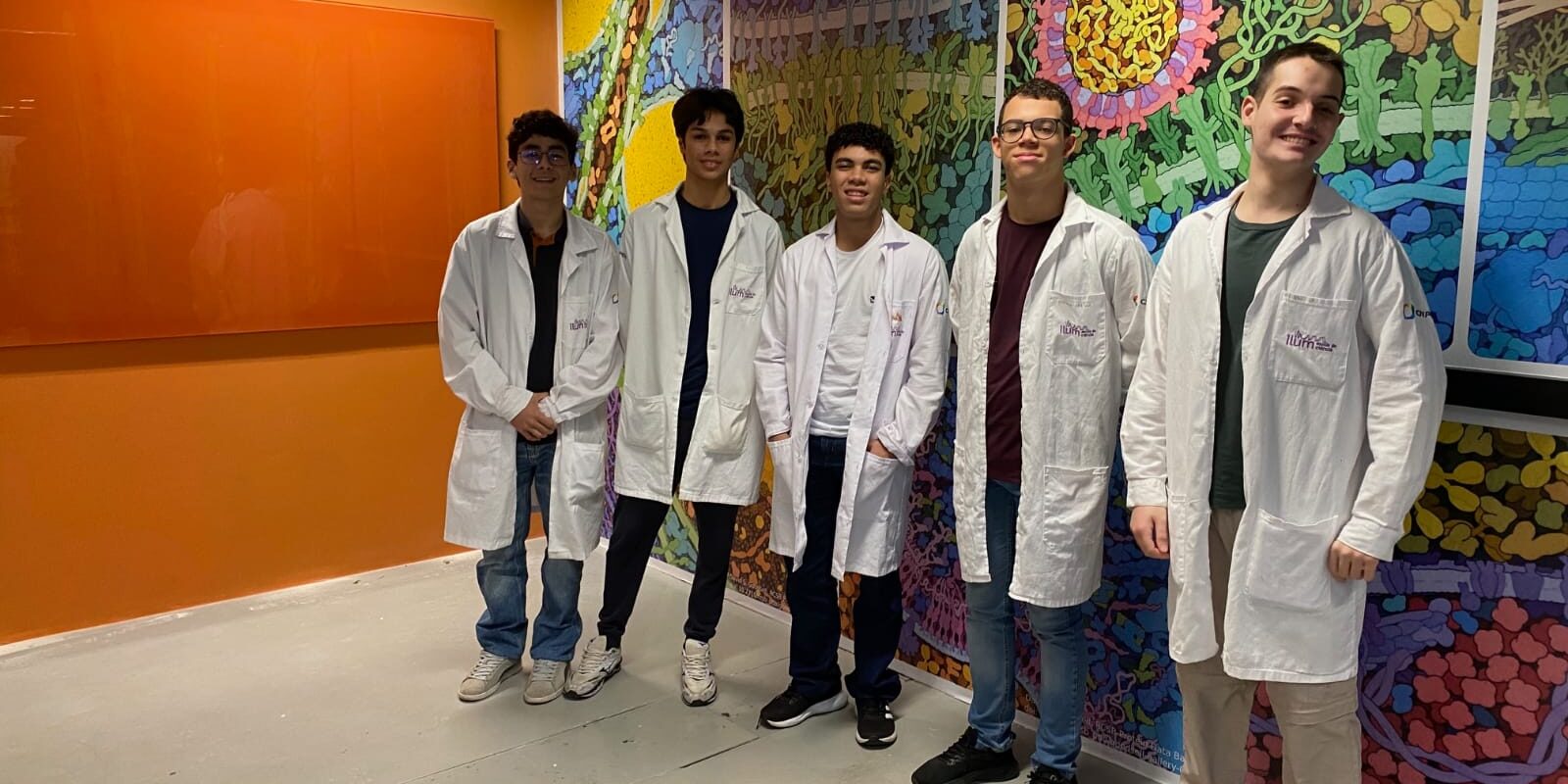
Between June 29 and July 3, five medal-winning students in the Brazilian Physics Olympiad for Public Schools (OBFEP) carried out a week of scientific immersion at CNPEM (Brazilian Center for Research in Energy and Materials), with activities concentrated particularly at the Ilum School of Science. Coming from different regions of the country — Macaé (RJ), Teresina (PI), Maceió (AL), Porto Alegre (RS) and Belo Horizonte (MG) —, the students had direct contact with cutting-edge laboratories, participated in practical experiments and spoke with researchers from different areas. An experience that, according to them, went far beyond what they imagined when they received the invitation.
A week of cutting-edge science
Throughout the week, students went through activities that crossed different areas of knowledge: lectures on artificial intelligence and fuzzy mathematics, a visit to Sirius and its beamlines, a Rayleigh scattering experiment, a bioinformatics workshop, diffraction and microscopy activities, and a discussion on machine learning applied to materials science. The routine also included technical visits to bioscience, nanotechnology, and biorenewable infrastructures, as well as the Orion training center, and concluded with a brainstorming session on open scientific problems and the collective drafting of a report on the experience.
“Everyone recognizes the importance of this”
For professor Ana Carolina de Mattos Zeri, one of the organizers of the initiative, receiving the medalists is directly linked to the mission of Ilum and CNPEM to bring children and young people closer to science. “This is part of our mission: to encourage interest in science among children and young people, regardless of the path they take later”, she says.
Ana Zeri also highlighted how much the week broadened the way these young people see science. “The problems we solve in the Olympics are already known, someone already knows the answer. In real life, we deal with problems that still don’t have an answer and it is very important for them to see this connection. They used to imagine physics, engineering, and pure science as separate boxes, but they are now able to see the intersection between all these areas”, she says.
What do medalists take away from the experience?
For the students, the visit served as a gateway to a universe that was until then far away from the school routine. Felipe Gomes da Costa Gandini, 17 years old, from Macaé (RJ), highlighted the interdisciplinary nature of the course: “It’s very interesting to see how they relate very specific parts of physics research to biology, to materials.”
Cauê Carvalho da Costa Gonçalves, 17, from Teresina (PI), is interested in technology and engineering. For him, the week at CNPEM opened a new horizon: “Knowing the dynamics of the classes here, the entire infrastructure and everything related to the campus, it is becoming a future possibility to enroll here.”
João Gabriel, 18, from Maceió (AL), had already visited Ilum and CNPEM in 2024. But this time, he was able to delve deeper into the school’s interdisciplinary experience: “It’s a truly transformative experience: training the next scientists, who will contribute with solutions to the future.”
Vinícius Reis de Oliveira, 17, from Belo Horizonte (MG), highlighted how much the practical experience differed from what he is used to studying in the classroom: “It is very rare to have this opportunity, in such an advanced research center, to be able to have a series of practical activities. This is the first time I’ve had this experience.”
Accessible science and development of new talents
The initiative reinforces the commitment of CNPEM and its undergraduate program, Ilum, to bring talented young people from public schools closer to the world of scientific research, showing that science can be an accessible and transformative path. During the five days of activities, the students had their airfare, lodging, and local transportation costs covered by CNPEM/Ilum, ensuring the presence of representatives from different regions of Brazil.
More than a technical visit, the week provided the five medalists with a complete experience in the frontier science environment, connecting promising young people to researchers, laboratories, and challenges that help to build the scientific solutions of the future.futuro.