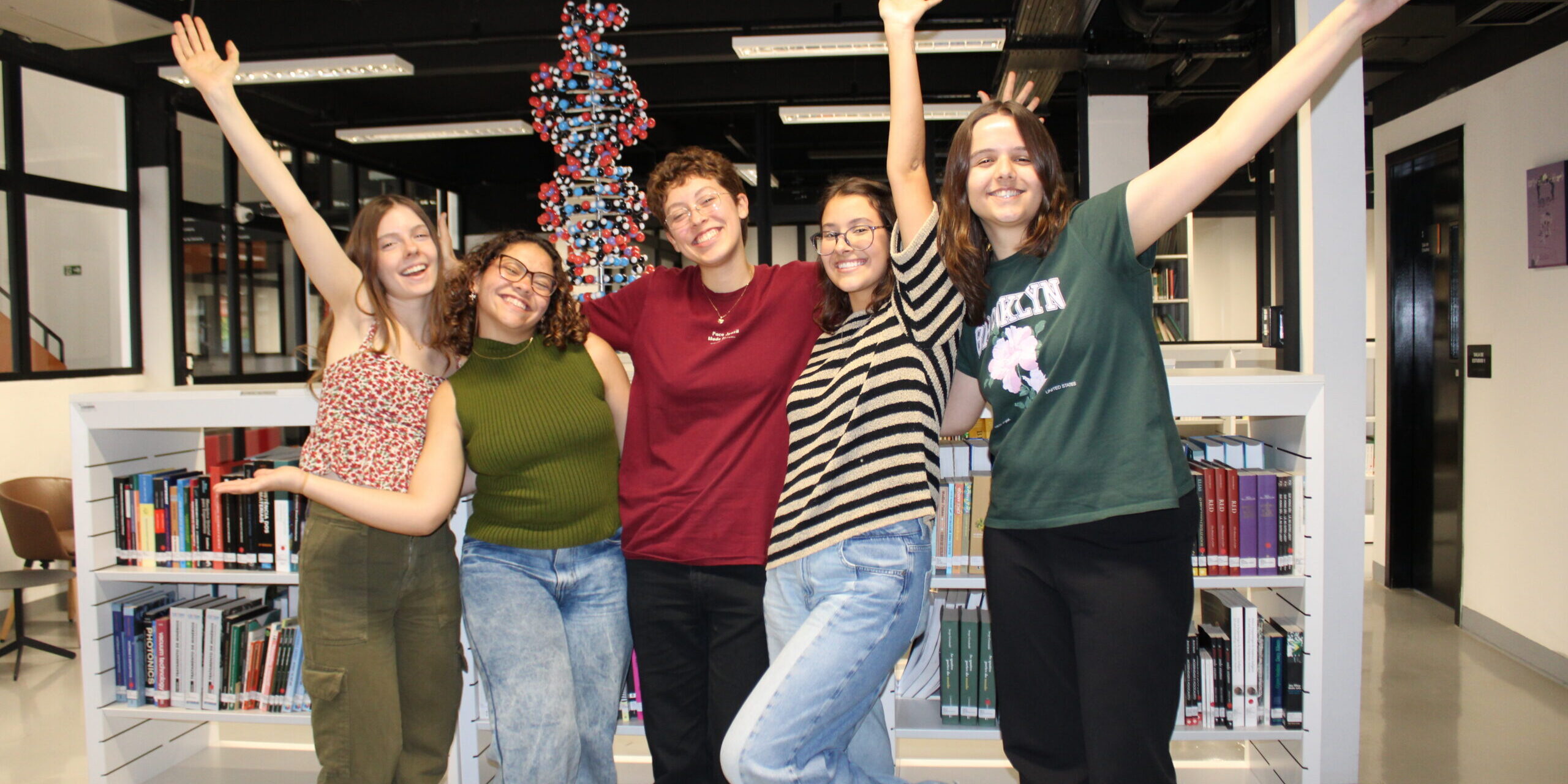
A team made up of female students from the CNPEM undergraduate course, Ilum School of Science, won first place in the Unicamp Challenge, the main competition for business models based on technologies patented by the university. The LumiNova team took home the trophy in the Panel Evaluation category and also won the Popular Vote, a double achievement in an edition that brought together 324 registered participants, 80 teams, and participants from 54 different institutions.
The winning project was based on the patented AgNMS complex, a formulation that combines silver ions with an anti-inflammatory agent to optimize the topical treatment of skin cancer. Based on this technology—developed within the scope of CEPID CancerThera—the students created a comprehensive business plan, which was presented to the judging panel following months of mentoring, workshops, and commercial feasibility studies.
This seamless transition between the technical language of a pharmaceutical patent and the logic of a business plan did not happen by chance; it is a direct reflection of Ilum’s educational model, which combines immersion in cutting-edge research with courses focused on innovation and scientific entrepreneurship from the very first semesters.
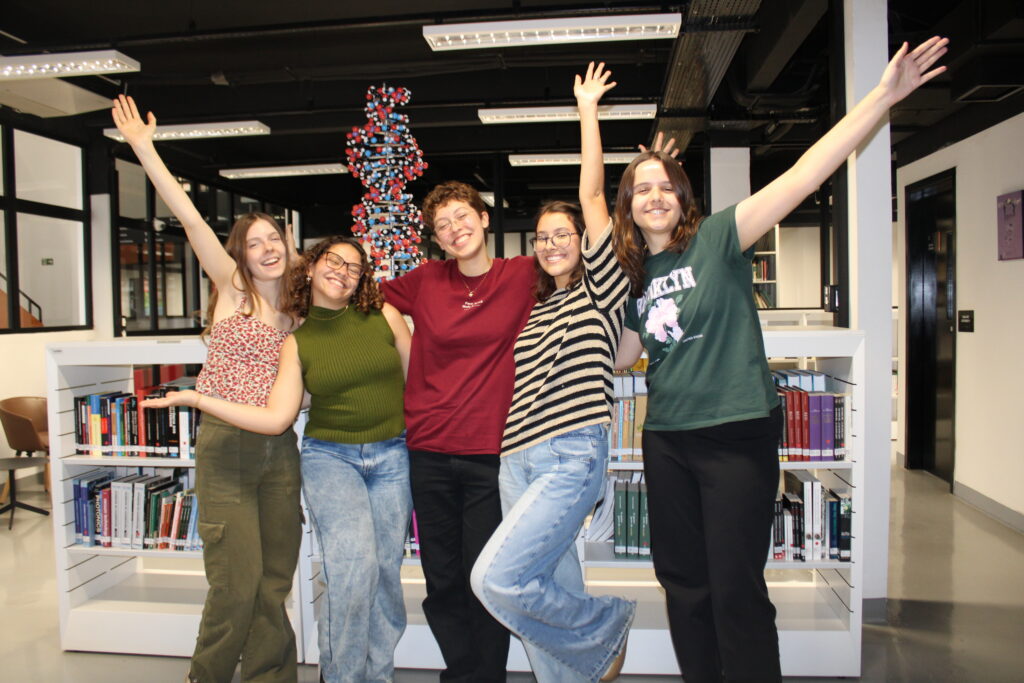
Lília Gavazza, who brought the group together, says that the team was looking for a project that would combine the different areas of interest of its members with a strong market appeal. Upon learning about the AgNMS technology, the response was immediate: “When we saw this project, everyone was very excited. And the more we studied it, realizing the scope of the project, the more excited we became about it.”
The trajectory intersected directly with the training offered by the School. The students took the course Modeling and Innovative Ventures during the same period in which they competed in the challenge. For Lívia Aragão, the experiences complemented each other: “We were learning a lot about the field, both from Professor Aline (Pascon) and through the challenge itself. This was very important because we discovered concepts, people, and key details that we might not have fully grasped otherwise.”
For Mariana Melo Pereira, the experience reinforced a principle that already guides Ilum’s educational approach: the idea that research only makes sense when it reaches society. “It makes no sense for us to produce science without giving something back to society. It is precisely innovation and entrepreneurship that bring about this thinking, so that we can make technologies accessible to the greatest number of people”, she says.
This same formative logic appears in the way the team organized its own group work. Gisela Kassick remembers that, with an intense mentoring schedule simultaneously with classes at Ilum, it was not always possible for all members to participate in each stage of the competition, and that the habit of passing on knowledge between colleagues, common in the School’s routine, was decisive: “What often happened was that only one or two of us participated in a mentoring session, and the knowledge we acquired there was passed on to the others. This made each part of the project that one of us did truly connected, not isolated parts.”
Samarah Ramos highlights the significance of proposing a solution that can effectively reach the Brazilian Unified Health System (SUS). For her, participating in the development of a business model focused on the SUS reinforces what she considers the greatest value of innovation: “Skin cancer is the most common type of cancer in Brazil. Being able to provide a treatment for a disease that affects so many people, and making this process easier, is a huge milestone for us.”
In addition to the symbolic recognition of being the first Ilum class to reach the top of the competition, the victory earned the team a cash prize, a year of training from the FM2S consultancy, and access to mentoring from Baita Aceleradora, Inova Unicamp’s business incubator aimed at turning projects like those of the students into reality. The group is already in contact with the incubator’s project management team to continue with the next steps for the technology.
About the Ilum School of Science OU About Ilum
Ilum offers a free undergraduate degree program that utilizes an interdisciplinary approach to train scientists and professionals in science and technology. With an innovative educational model, the three-year full-time bachelor program offers courses that connect life sciences, materials science, data science, artificial intelligence, and the humanities in order to prepare researchers to work in an ethical and collaborative manner in the search for solutions to the global challenges of the twenty-first century. The Ilum School of Science is funded by the Brazilian Ministry of Education (MEC) and is part of the Brazilian Center for Research in Energy and Materials (CNPEM) in Campinas, São Paulo, a social organization overseen by the Ministry of Science, Technology, and Innovation (MCTI). Ilum’s educational mission offers early contact with experimental activities, in teaching labs at the school as well as at CNPEM, in projects carried out together with researchers.
About CNPEM
The Brazilian Center for Research in Energy and Materials (CNPEM) is home to a state-of-the-art, multi-user and multidisciplinary scientific environment and works on different fronts within the Brazilian National System for Science, Technology and Innovation. A social organization overseen by the Ministry of Science, Technology and Innovation (MCTI), CNPEM is driven by research that impacts the areas of health, energy, renewable materials, and sustainability. It is responsible for Sirius, the largest assembly of scientific equipment constructed in the country, and is currently constructing Project Orion, a laboratory complex for advanced pathogen research. Highly specialized science and engineering teams, sophisticated infrastructure open to the scientific community, strategic lines of investigation, innovative projects involving the productive sector, and training for researchers and students are the pillars of this institution that is unique in Brazil and able to serve as a bridge between knowledge and innovation. CNPEM’s research and development activities are carried out through its four National Laboratories: Synchrotron Light (LNLS), Biosciences (LNBio), Nanotechnology (LNNano), Biorenewables (LNBR), as well as its Technology Unit (DAT) and the Ilum School of Science — an undergraduate program in Science and Technology supported by the Ministry of Education (MEC).
https://cnpem.br/en/Sobre o CNPEM