The equipment allows for the investigation of materials at the nanoscale and expands students’ access to an advanced scientific research technique
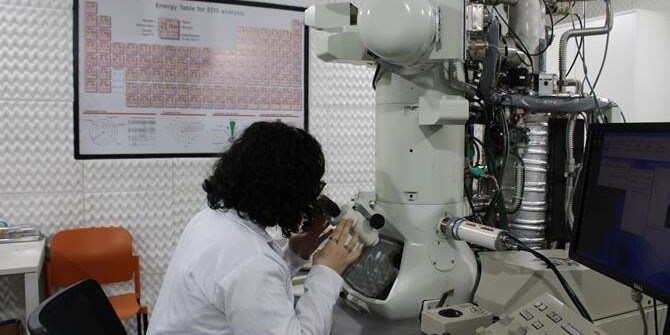
Ilum School of Science, the undergraduate program in Science and Technology at CNPEM (Brazilian Center for Research in Energy and Materials), now has a transmission electron microscope (TEM), equipment that uses an advanced characterization technique capable of analyzing materials thousands of times smaller than a human hair, found mainly in advanced research centers. Previously housed at the CNPEM Nanotechnology unit, the JEOL TEM-2100 is now dedicated exclusively to undergraduate activities. With it, students will be able to investigate materials at extremely small scales, incorporating transmission electron microscopy into the teaching and research activities developed throughout the course.
Segundo a professora Valéria Spolon Marangoni, coordenadora de laboratórios da Ilum, o microscópio será incorporado às práticas de disciplinas experimentais e também a projetos de pesquisa dos estudantes. “Já nesta etapa inicial, o equipamento está sendo disponibilizado para atividades didáticas de Laboratórios Avançados, Iniciação à Pesquisa I e Projetos Finais”, explica.
According to Professor Valéria Spolon Marangoni, coordinator of laboratories at Ilum, the microscope will be incorporated into the practices of experimental disciplines and also into students’ research projects. “Even at this initial stage, the equipment is being made available for educational activities in Advanced Laboratories, Introduction to Research I, and Final Projects”, she explains. This new equipment reinforces the institution’s pedagogical approach, which combines technical experience and theory. “The idea is that students not only have theoretical contact with electron microscopy, but can understand how the technique works, follow the preparation and analysis of their own samples and, progressively, participate in obtaining and interpreting the data”, says Valéria Spolon.
What the microscope allows you to see
Imagine looking at something thousands of times smaller than the thickness of a human hair. It is at this scale that Ilum’s transmission electron microscope operates. Instead of light, it uses an electron beam that passes through the sample and generates extremely high-resolution images.
Mas o equipamento mostra mais do que a forma dos materiais observados: ele também permite investigar como os átomos estão organizados, o que os cientistas chamam de estrutura cristalina, além de identificar a composição dos elementos químicos. Essas informações são importantes porque essas características influenciam diretamente as propriedades do objeto analisado.
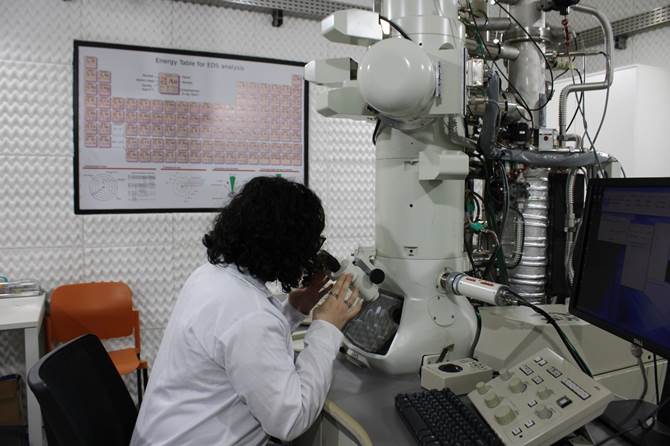
Still undergoing technical adjustments, the microscope, which will be definitively incorporated into the curriculum in 2027, already allows for the analysis of the shape and size of inorganic nanomaterials of approximately 15 nanometers, which is more than 5,000 times smaller than a human hair, which is about 80,000 nanometers thick. In another comparison, the new equipment can analyze substances approximately seven times smaller than the COVID-19 virus, which, however, requires biosafety level 3 laboratories to be handled.
“More than simply expanding Ilum’s equipment park, TEM strengthens a central characteristic of the education we seek: bringing the student closer, from undergraduate studies onwards, to the way science is effectively applied”, points out Spolon. She highlights that the student can participate in all stages of a scientific problem: producing material, formulating hypotheses, characterizing it using different techniques, analyzing data, and relating structure, composition and properties. According to the professor, Ilum already employs other advanced techniques, such as atomic force microscopy and optical spectroscopy.
Access to the technique in undergraduate studies
Some universities offer access to and training in transmission electron microscopy to undergraduate students, but this usually occurs in the context of research projects or specific training programs in multi-user facilities. The systematic integration of TEM into various curricular projects and undergraduate activities, as proposed by Ilum, is still an unusual initiative in the national and international context.
Lise Meitner Laboratory: dedicated infrastructure
The microscope will be installed in the new Lise Meitner Laboratory, a space built specifically to house the equipment. The operation of a transmission electron microscope requires a climate-controlled environment to meet the equipment’s technical requirements.
The laboratory is named in honor of one of the most important physicists of the 20th century. Born in Vienna, Austria, in 1878, Lise Meitner (1878-1968) overcame the barriers imposed on women in science in her time and earned a doctorate in physics in 1906. She built her career in Germany, where she worked for three decades with chemist Otto Hahn on research into radioactivity and the structure of the atom. Forced to leave the country in 1938 because of her Jewish origin, she continued her research in Sweden. From there, together with her nephew, physicist Otto Frisch, she explained, from a theoretical point of view, how the nucleus of the atom can divide, a process known as nuclear fission. The discovery, which helped change the course of science, earned Hahn the 1944 Nobel Prize in Chemistry, and Meitner’s contribution was only widely recognized decades later. In her honor, the chemical element number 109 on the periodic table was named meitnerium.
Abou Ilum
Ilum offers a free undergraduate degree program that utilizes an interdisciplinary approach to train scientists and professionals in science and technology. With an innovative educational model, the three-year full-time bachelor program offers courses that connect life sciences, materials science, data science, artificial intelligence, and the humanities in order to prepare researchers to work in an ethical and collaborative manner in the search for solutions to the global challenges of the twenty-first century. The Ilum School of Science is funded by the Brazilian Ministry of Education (MEC) and is part of the Brazilian Center for Research in Energy and Materials (CNPEM) in Campinas, São Paulo, a social organization overseen by the Ministry of Science, Technology, and Innovation (MCTI). Ilum’s educational mission offers early contact with experimental activities, in teaching labs at the school as well as at CNPEM, in projects carried out together with researchers.
About CNPEM
The Brazilian Center for Research in Energy and Materials (CNPEM) is home to a state-of-the-art, multi-user and multidisciplinary scientific environment and works on different fronts within the Brazilian National System for Science, Technology and Innovation. A social organization overseen by the Ministry of Science, Technology and Innovation (MCTI), CNPEM is driven by research that impacts the areas of health, energy, renewable materials, and sustainability. It is responsible for Sirius, the largest assembly of scientific equipment constructed in the country, and is currently constructing Project Orion, a laboratory complex for advanced pathogen research. Highly specialized science and engineering teams, sophisticated infrastructure open to the scientific community, strategic lines of investigation, innovative projects involving the productive sector, and training for researchers and students are the pillars of this institution that is unique in Brazil and able to serve as a bridge between knowledge and innovation. CNPEM’s research and development activities are carried out through its four National Laboratories: Synchrotron Light (LNLS), Biosciences (LNBio), Nanotechnology (LNNano), Biorenewables (LNBR), as well as its Technology Unit (DAT) and the Ilum School of Science — an undergraduate program in Science and Technology supported by the Ministry of Education (MEC).