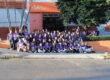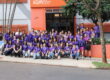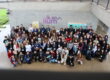
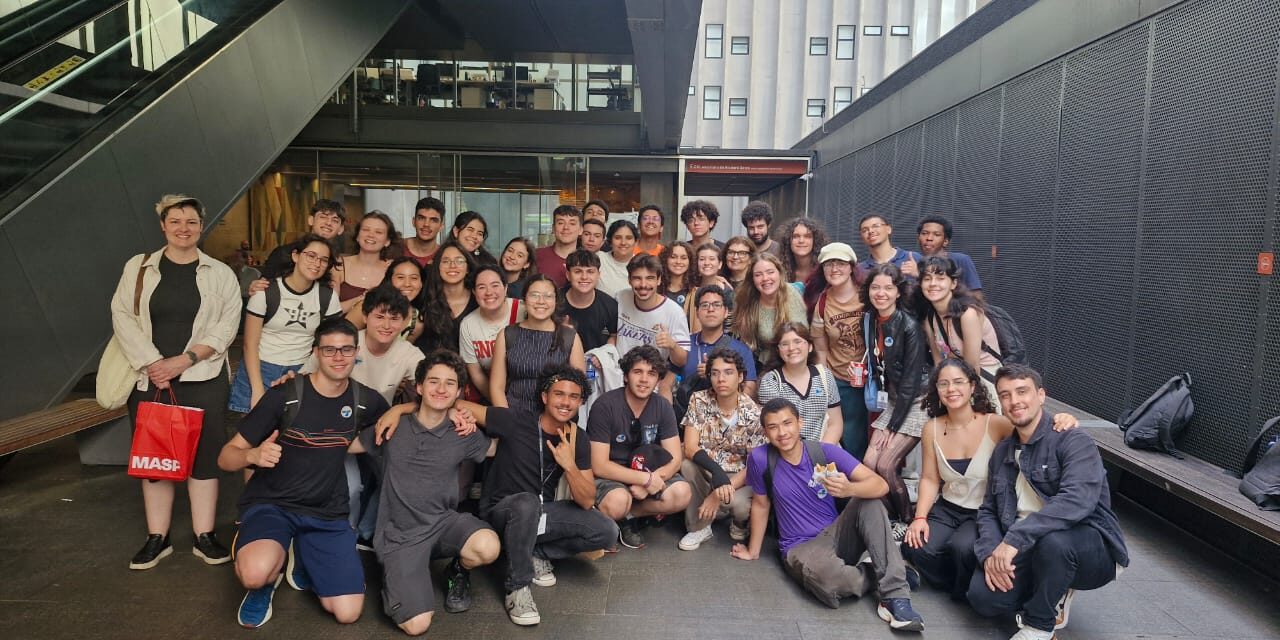
First-year students from the Ilum School of Science, the undergraduate course in sciences offered by CNPEM (Brazilian Center for Research in Energy and Materials), were in São Paulo for one of the most traditional activities on the institution’s calendar: the cultural visit held annually in the second semester.
The proposal is to offer students the opportunity to visit other spaces and take on other perspectives. Although it is not a formal objective, the debates held in the classroom tend to be echoed in the exhibitions visited, which reinforces the connection between the curriculum and what is happening in the world.
The tour began at the Museu de Arte de São Paulo (Masp), where they visited the museum’s long-term exhibition, which brings together renowned names, such as Picasso and Anita Malfatti, alongside contemporary Brazilian artists, and were able to check out the temporary exhibition “Latin American Stories”.
Afterwards, the group visited the Moreira Salles Institute, where they were able to observe an exhibition of photographs linked to the Black Movement, highlighting Laudelina de Campos Mello, one of the pioneers of the Black Women’s Movement in Brazil.
Autonomy and city experience
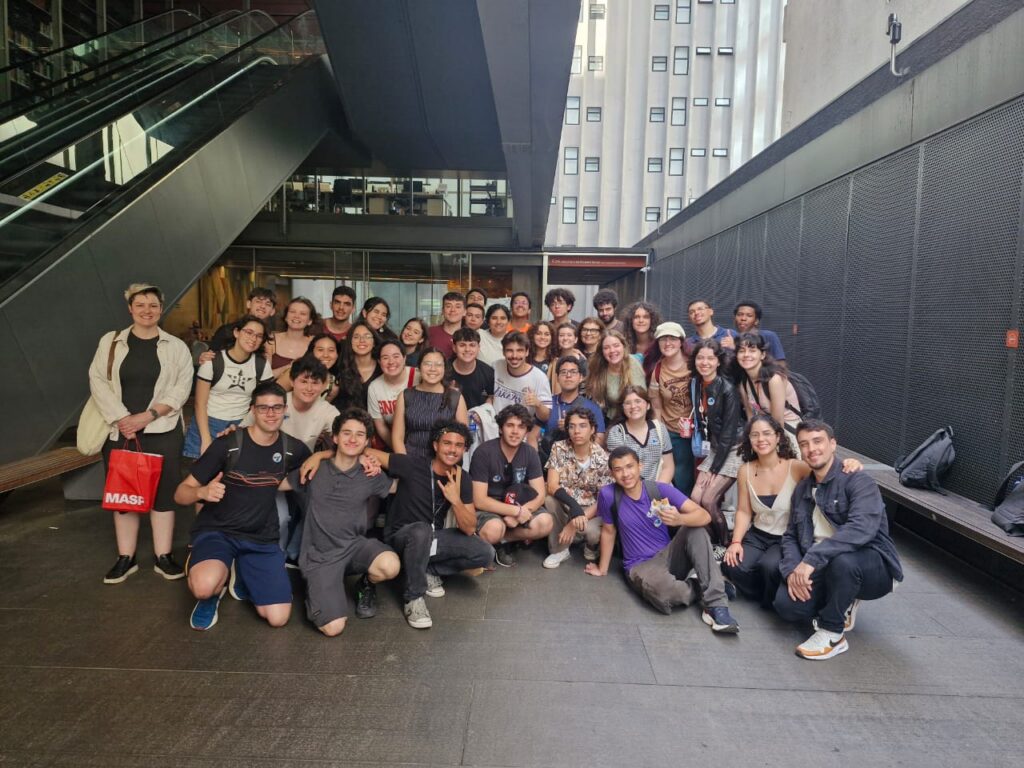
In addition to the guided tours, students had free time, such as during the lunch break, to experience the capital of São Paulo State. Some had lunch on Avenida Paulista itself, while others used transport apps to go to other neighborhoods. There were also those who used the subway for the first time.
The visit to São Paulo reflects one of the hallmarks of Ilum’s pedagogical proposal: interdisciplinary training. At the School, scientific knowledge is constructed in an integrated way, uniting the exact sciences with the human sciences, with the debate about the contemporary world and with the sensitivity to understand different realities, which includes contact with art and culture.
By circulating through museums, exhibitions and cultural spaces, students expand their repertoires, learn about new references and exercise a critical outlook at issues that also cross the curriculum, such as the environmental crisis, Latin American identity and the history of historically invisible groups. At the same time, they develop autonomy and learn to occupy the city, skills that are equally important for those preparing to act as scientists and citizens.
About the Ilum School of Science
Ilum offers a free undergraduate degree program that utilizes an interdisciplinary approach to train scientists and professionals in science and technology. With an innovative educational model, the three-year full-time bachelor program offers courses that connect life sciences, materials science, data science, artificial intelligence, and the humanities in order to prepare researchers to work in an ethical and collaborative manner in the search for solutions to the global challenges of the twenty-first century. The Ilum School of Science is funded by the Brazilian Ministry of Education (MEC) and is part of the Brazilian Center for Research in Energy and Materials (CNPEM) in Campinas, São Paulo, a social organization overseen by the Ministry of Science, Technology, and Innovation (MCTI). Ilum’s educational mission offers early contact with experimental activities, in teaching labs at the school as well as at CNPEM, in projects carried out together with researchers.
About CNPEM
The Brazilian Center for Research in Energy and Materials (CNPEM) is home to a state-of-the-art, multi-user and multidisciplinary scientific environment and works on different fronts within the Brazilian National System for Science, Technology and Innovation. A social organization overseen by the Ministry of Science, Technology and Innovation (MCTI), CNPEM is driven by research that impacts the areas of health, energy, renewable materials, and sustainability. It is responsible for Sirius, the largest assembly of scientific equipment constructed in the country, and is currently constructing Project Orion, a laboratory complex for advanced pathogen research. Highly specialized science and engineering teams, sophisticated infrastructure open to the scientific community, strategic lines of investigation, innovative projects involving the productive sector, and training for researchers and students are the pillars of this institution that is unique in Brazil and able to serve as a bridge between knowledge and innovation. CNPEM’s research and development activities are carried out through its four National Laboratories: Synchrotron Light (LNLS), Biosciences (LNBio), Nanotechnology (LNNano), Biorenewables (LNBR), as well as its Technology Unit (DAT) and the Ilum School of Science — an undergraduate program in Science and Technology supported by the Ministry of Education (MEC).