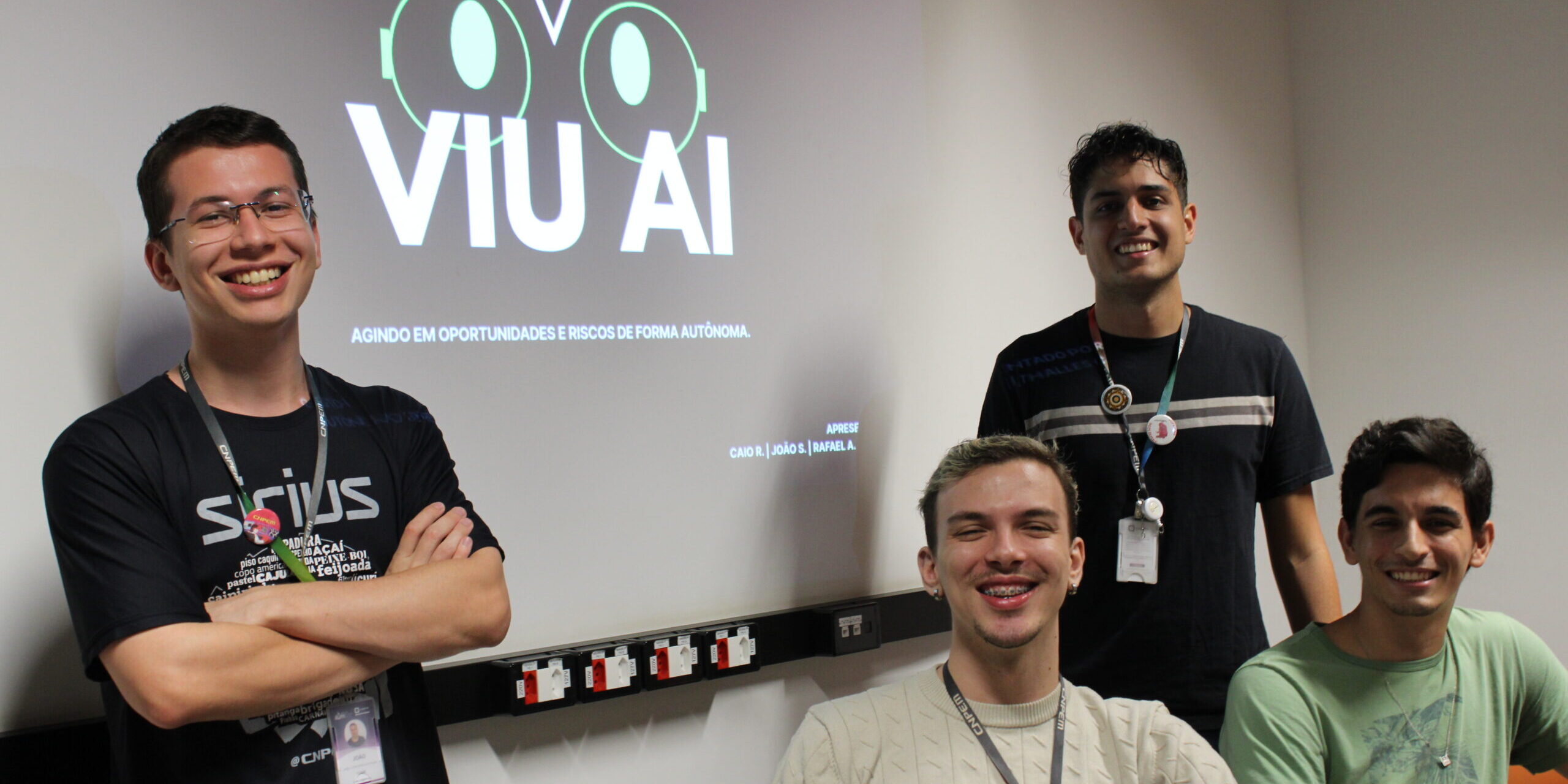
Three students in their final year at the Ilum School of Science, the undergraduate degree program offered by the Brazilian Center for Research in Energy and Materials (CNPEM), won first place in Hack2L, a hackathon about AI agents held by Canastra Ventures and Liga Empreendedora in partnership with the UNICAMP Institute of Computation. The winning team comprised Ilum third-year students Rafael Anis Shaikhzadeh Santos of Salvador, Bahia, Caio Marcelo Cavallari Ruas of Tangará da Serra, Mato Grosso, and Thalles José de Souza Cansi of Cachoeiro de Itapemirim, Espirito Santo, as well as João Vitor Pires de Souza, a UNICAMP student majoring in statistics and interning at Ilum.
The competition drew approximately 50 participants divided over various teams. The challenge: use artificial intelligence agents to carry out manual and repetitive tasks that are part of everyday corporate routine. The teams had roughly four hours to design, program and prepare a presentation of their functional prototype to a panel of judges.
The winning team’s idea emerged on the eve of the event, during a casual meeting at one member’s home. The result was Viu AI, an agent designed to help companies manage their marketing and social media. The agent continuously monitors platforms like YouTube, LinkedIn, X (formerly Twitter) and Reddit for mentions of the company’s brand and determines whether the audience is reacting positively or negatively to a certain product or campaign. From this survey, the agent suggests content in line with market opportunities and points out risks such as potential damage to the brand’s reputation.
One of its differentials is what is called the closed loop: the agent not only plans posts but also monitors the performance of each after posting, closing the cycle between planning and results. This resource, according to the team, is not fully integrated into many tools that are currently available on the market. In their research conducted before they defined the scope of the project, the students found foreign competition offering similar functions but no direct competitor in the Brazilian market.
“It was something we really all came to together, we did some brainstorming and the idea emerged from the group. We can’t even say who came up with it first,” said Thalles José de Souza Cansi.
The students describe their routine at Ilum as decisive in their performance during the presentation stage; normally this is the most delicate part of a hackathon, when teams have only minutes to demonstrate to the judges the value of what they built under pressure.
“We get very used to always presenting projects to a panel that is willing to evaluate and point out opportunities for improvement. So when we had to pitch the idea, even without much time to prepare or practice, it was natural for us,” said Rafael Anis Shaikhzadeh Santos, noting that the panel specifically highlighted the team’s consistency in meeting all the criteria.
The group credits their win to the combination of subjects they study at Ilum, where artificial intelligence, data science and entrepreneurship are part of the curriculum. Their classes in machine learning and AI gave them the technical foundation to program the agent, while the subjects focusing on startups taught them to come up with a business model and summarize a complex idea into a three-minute pitch.
About the Ilum School
Ilum offers a free undergraduate degree program that utilizes an interdisciplinary approach to train scientists and professionals in science and technology. With an innovative educational model, the three-year full-time bachelor program offers courses that connect life sciences, materials science, data science, artificial intelligence, and the humanities in order to prepare researchers to work in an ethical and collaborative manner in the search for solutions to the global challenges of the twenty-first century. The Ilum School of Science is funded by the Brazilian Ministry of Education (MEC) and is part of the Brazilian Center for Research in Energy and Materials (CNPEM) in Campinas, São Paulo, a social organization overseen by the Ministry of Science, Technology, and Innovation (MCTI). Ilum’s educational mission offers early contact with experimental activities, in teaching labs at the school as well as at CNPEM, in projects carried out together with researchers.
About CNPEM
The Brazilian Center for Research in Energy and Materials (CNPEM) is home to a state-of-the-art, multi-user and multidisciplinary scientific environment and works on different fronts within the Brazilian National System for Science, Technology and Innovation. A social organization overseen by the Ministry of Science, Technology and Innovation (MCTI), CNPEM is driven by research that impacts the areas of health, energy, renewable materials, and sustainability. It is responsible for Sirius, the largest assembly of scientific equipment constructed in the country, and is currently constructing Project Orion, a laboratory complex for advanced pathogen research. Highly specialized science and engineering teams, sophisticated infrastructure open to the scientific community, strategic lines of investigation, innovative projects involving the productive sector, and training for researchers and students are the pillars of this institution that is unique in Brazil and able to serve as a bridge between knowledge and innovation. CNPEM’s research and development activities are carried out through its four National Laboratories: Synchrotron Light (LNLS), Biosciences (LNBio), Nanotechnology (LNNano), Biorenewables (LNBR), as well as its Technology Unit (DAT) and the Ilum School of Science — an undergraduate program in Science and Technology supported by the Ministry of Education (MEC).