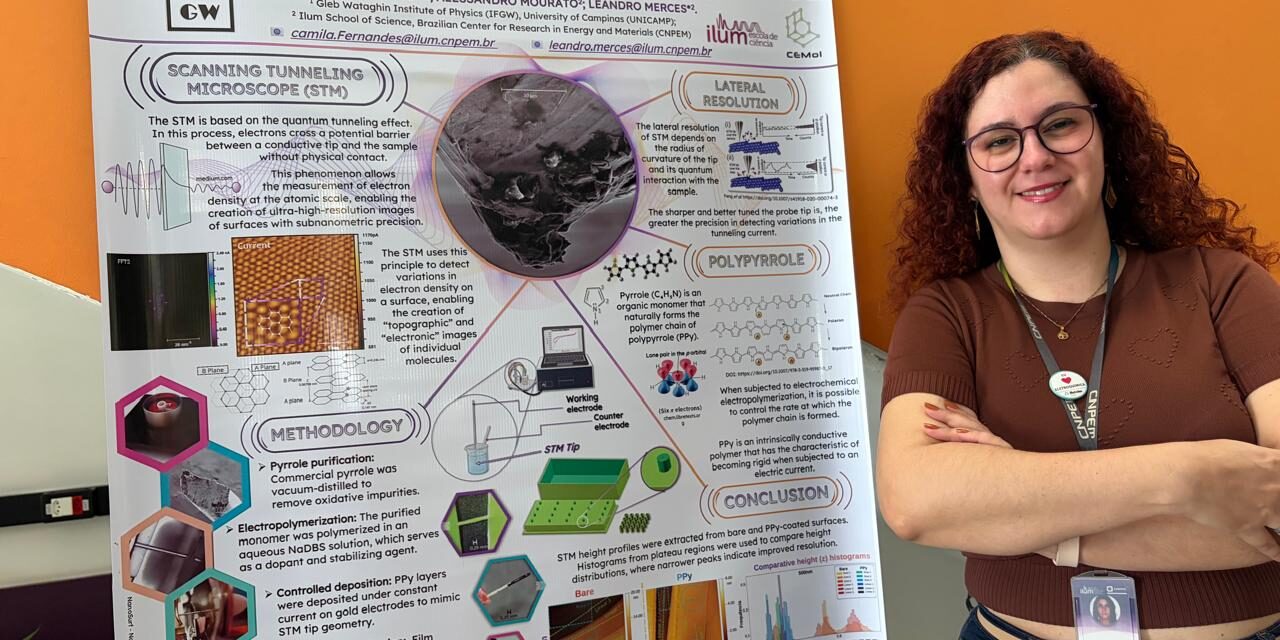
Student Camila Desiderio Fernandes was the winner of the best poster category at the Women in Quantum Physics (SheQ) event held by the University of São Paulo’s Institute of Physics (IFUSP). The award recognizes her undergraduate research project conducted in the life science and materials science laboratories at the Ilum School of Science, the undergraduate degree program offered by the Brazilian Center for Research in Energy and Materials (CNPEM).
At the SheQ event, Camila presented some of her groundbreaking data in a poster format, which won her first place. SheQ is more than just a showcase for scientific results: it brought together different generations of researchers to share not only their projects in the area of quantum physics, but also how they got where they are today.
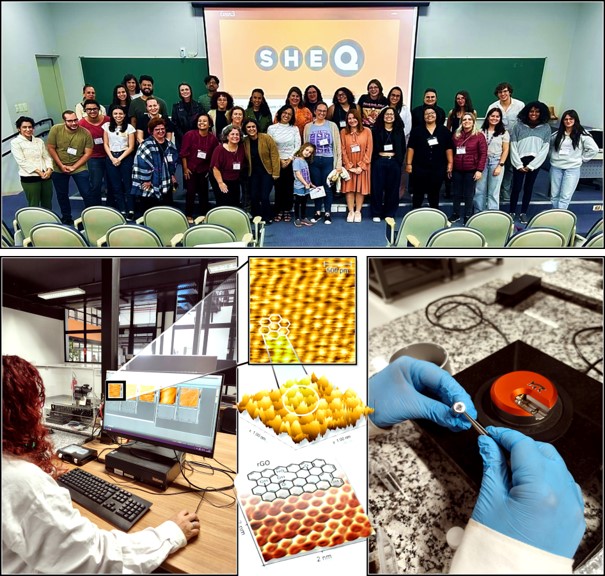
Camila, who was advised by Ilum professor and researcher Dr. Leandro Mercês, is the recipient of a CNPq undergraduate research fellowship through the PIBIC/CNPEM program and is in the final stages of completing her degree in physics with a teaching credential at Campinas State University (UNICAMP). Camila notes that her entire research trajectory basically took place within the multidisciplinary labs at Ilum/CNPEM: “I use practically all of the Ilum labs, especially the John Bardeen Lab, which has the tunneling microscope utilized in my research.” And it is precisely this access to cutting-edge infrastructure that underlies her award-winning project.
In her research project, Camila works to functionalize the probes used in scanning tunneling microscopy (STM), a technique which can see atoms on the surface of a sample. The probe is made of a platinum/iridium alloy prepared specifically for the STM experiment. In order to explore the interactions between the probe and the surface of the sample, the study proposed covering this metal alloy with a thin film of an electrochemically-deposited conductive polymer. This polymer accumulates to form thin threads, making it possible to create a finer point and in turn achieve greater stability and higher resolution in the image of the analyzed surface. The importance of STM imagery at the atomic scale was recently confirmed in a collaborative project involving Camila, which was published in the journal Advanced Materials Interfaces. In this study, STM was essential to reveal hybrid structures formed by quantum materials of technological interest, namely reduced graphene oxide nanosheets functionalized with molybdenum disulfide bilayers. The full article can be found at https://doi.org/10.1002/admi.70639.
For Camila, initiatives like the SheQ event at IFUSP have major potential to encourage more girls to choose professions involving the natural sciences and engineering. She notes that these fields lack gender balance in various sub-areas. “In my undergraduate course in physics, for example, there are some elective subjects like computational physics where I’m the only girl in the class. And in some experimental subjects, most of the class is also men,” she added. Being recognized in a historically male space had a special meaning for her: “I was really happy. It is really great to see our work recognized at an event like this,” she concluded.
About the Ilum School of Science
Ilum offers a free undergraduate degree program that utilizes an interdisciplinary approach to train scientists and professionals in science and technology. With an innovative educational model, the three-year full-time bachelor program offers courses that connect life sciences, materials science, data science, artificial intelligence, and the humanities in order to prepare researchers to work in an ethical and collaborative manner in the search for solutions to the global challenges of the twenty-first century. The Ilum School of Science is funded by the Brazilian Ministry of Education (MEC) and is part of the Brazilian Center for Research in Energy and Materials (CNPEM) in Campinas, São Paulo, a social organization overseen by the Ministry of Science, Technology, and Innovation (MCTI). Ilum’s educational mission offers early contact with experimental activities, in teaching labs at the school as well as at CNPEM, in projects carried out together with researchers.
About CNPEM
The Brazilian Center for Research in Energy and Materials (CNPEM) is home to a state-of-the-art, multi-user and multidisciplinary scientific environment and works on different fronts within the Brazilian National System for Science, Technology and Innovation. A social organization overseen by the Ministry of Science, Technology and Innovation (MCTI), CNPEM is driven by research that impacts the areas of health, energy, renewable materials, and sustainability. It is responsible for Sirius, the largest assembly of scientific equipment constructed in the country, and is currently constructing Project Orion, a laboratory complex for advanced pathogen research. Highly specialized science and engineering teams, sophisticated infrastructure open to the scientific community, strategic lines of investigation, innovative projects involving the productive sector, and training for researchers and students are the pillars of this institution that is unique in Brazil and able to serve as a bridge between knowledge and innovation. CNPEM’s research and development activities are carried out through its four National Laboratories: Synchrotron Light (LNLS), Biosciences (LNBio), Nanotechnology (LNNano), Biorenewables (LNBR), as well as its Technology Unit (DAT) and the Ilum School of Science — an undergraduate program in Science and Technology supported by the Ministry of Education (MEC).